Neural Networks & Deep Learning: A Systems View
An engineer-first reference for how deep nets behave: architecture, optimization, compute constraints, and failure modes.
By Ryan Setter
Deep learning is not magic. It's a very large, very flexible function fitted to data with gradient-based optimization.
The engineering difficulty is not understanding the math. It's understanding the behavior that falls out of:
- a high-dimensional parameter space,
- an optimization process that only sees local gradients,
- noisy data that encodes your organization more than your domain,
- and hardware constraints that turn theory into scheduling.
This article is an evergreen, systems-minded map of the territory: what neural networks are in practice, why they scale, and how they fail when you push them into production.
The core object: a parameterized program you can differentiate
A neural network is a function:
f(x; θ) -> y
xis input data.θis a (usually huge) set of parameters.yis an output: a class label, a probability distribution, a vector embedding, a sequence of tokens, etc.
The deep learning trick is not the network. It's the differentiability contract:
- Choose a loss function
L(y, target). - Compute gradients
∂L/∂θefficiently with automatic differentiation. - Update parameters with an optimizer.
If you can build the forward pass, modern frameworks will build the backward pass. That is why deep learning feels like software engineering with different failure modes.
Dry observation: deep learning is what happens when you make programs differentiable and then let the optimizer write the parts you used to hand-code.
Forward pass, loss, gradients: the compute graph as the real artifact
For architecture work, it helps to think in graphs, not layers.
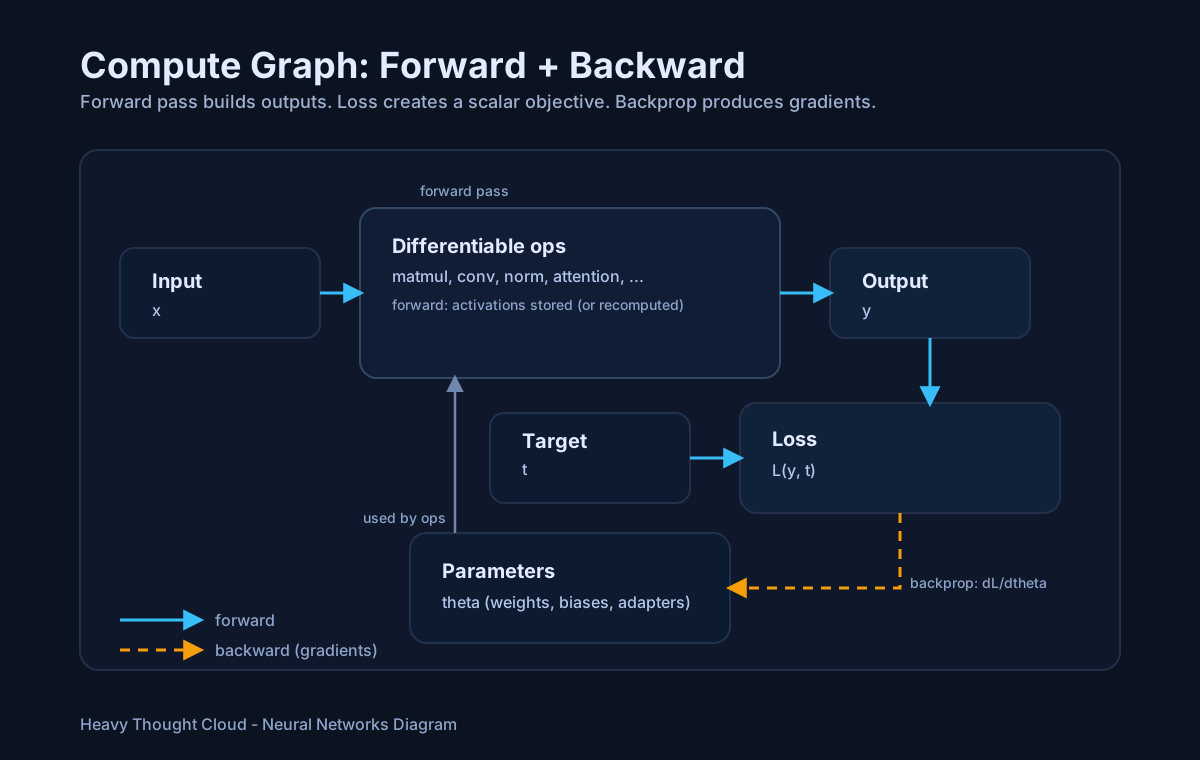
Figure 1. The compute graph is the real artifact: forward pass produces outputs; loss produces a scalar objective; backprop produces gradients that drive parameter updates.
The key properties of this graph:
- Locality: gradients are local signals propagated through the graph via the chain rule.
- Composability: you can build surprisingly capable functions from a small set of primitives.
- State: training requires storing (or recomputing) intermediate activations; serving often does not.
Architects care because compute graphs imply budgets:
- Training cost scales with FLOPs + activation memory + communication (for distributed training).
- Inference cost scales with FLOPs + memory bandwidth + caching strategy (for sequence models).
Depth is representational leverage (and an optimization tax)
Depth buys compositional structure: later layers can build on earlier features.
- In vision, early layers often capture edges/textures; later layers capture parts/objects.
- In language models, early layers capture local token interactions; later layers capture longer-range abstractions.
Depth also creates optimization problems:
- vanishing/exploding gradients,
- sensitivity to initialization,
- training instabilities that look like "it suddenly got worse" because they often do.
Modern deep learning is largely a set of stabilization mechanisms that make deep networks trainable:
- residual connections,
- normalization layers,
- better optimizers and learning-rate schedules,
- architectural patterns that keep gradients usable.
Architectures are inductive bias, not branding
The same universal approximation arguments apply to many models. What differs is what they make easy to learn under finite data/compute.
MLPs (feed-forward networks)
MLPs are generic function approximators. They are also the baseline you return to when everything else is too opinionated.
Strengths:
- simple,
- fast kernels (matmul),
- good on tabular-ish embeddings.
Common weaknesses:
- no built-in locality or structure,
- can waste parameters learning invariances you could have encoded.
CNNs (convolutional networks)
Convolutions bake in translation equivariance and locality. You get better sample efficiency when local structure matters.
Why engineers still like them:
- predictable compute,
- strong priors for images and many signals,
- mature deployment toolchains.
RNNs and sequence recurrence
RNNs encode temporal structure via recurrence. They are conceptually clean and operationally awkward at scale (sequential dependencies limit parallelism).
Modern LLM-era systems rarely deploy classic RNNs for language, but the mental model still matters: recurrence is a memory mechanism with latency consequences.
Transformers and attention
Attention is content-addressed mixing: every token can condition on other tokens.
Operationally, Transformers are a trade:
- Training: highly parallelizable.
- Inference: dominated by memory (KV cache) and sequence length.
This is why inference engineering is often a VRAM budgeting exercise disguised as "model serving".
If your scaling plan does not include KV cache math, your scaling plan is a poem.
Diffusion, graph nets, and "other"
These are still neural networks. The differences are in:
- the training objective,
- the generative process,
- and the shape of the compute graph.
From a systems perspective, the useful question is: what are the latency/throughput characteristics, and where are the stability cliffs?
Training is a feedback system (with terrible sensors)
At a high level, training is control theory with noisy measurements:
θ_{t+1} = θ_t - α * optimizer(∇_θ L(θ_t))
Where the "sensor" is a minibatch estimate of the gradient.
Gradient descent variants (SGD, momentum, Adam)
- SGD: simple, often robust, sensitive to learning rate and batch size.
- Momentum: adds inertia; helps traverse ravines.
- Adam/AdamW: adaptive per-parameter scaling; great default, not a free lunch.
Important practical reality: the optimizer is part of your model. Changing it changes the learned function.
Learning rate is the highest-leverage knob
If you only want one rule:
- tune learning rate before you touch architecture.
Learning-rate schedules (warmup, cosine, step) are not style choices. They shape whether training reaches a good basin or just vibrates nearby.
Batch size is a systems decision with statistical consequences
Large batches:
- improve throughput,
- reduce gradient noise,
- increase communication efficiency in distributed setups.
They can also:
- harm generalization,
- require learning-rate scaling tricks,
- change the effective regularization.
Batch size is where ML theory meets GPU cluster accounting.
Regularization is how you buy generalization (and stability)
Common tools:
- weight decay,
- dropout (less common in some modern architectures, still useful),
- data augmentation,
- early stopping,
- label smoothing.
Regularization is not moral discipline. It's an explicit bias toward functions that behave well off the training set.
Data is the real interface (define the contract)
Most deep learning failures that look like "model issues" are data contract issues:
- label leakage,
- train/serve skew,
- silent schema drift,
- sampling bias,
- feedback loops (your model changes what data you collect next).
For engineers and architects, treat datasets like production dependencies:
- version them,
- document them,
- put invariants on them,
- and assume they will drift.
If you want a minimal dataset contract, start with:
dataset_id, version
source systems
label definition + edge cases
sampling rules (who/what is excluded)
time windows (to avoid leakage)
PII/compliance constraints
Generalization: why it doesn't just memorize (and when it does)
Neural networks can memorize. They also generalize remarkably well under the right conditions.
What helps in practice:
- strong inductive bias (architecture matches structure),
- implicit regularization from optimization dynamics,
- high-quality, diverse data,
- loss functions that reflect the actual objective.
What breaks it:
- training data that encodes shortcuts (spurious correlations),
- distribution shift (production is not i.i.d.),
- evaluation leakage (your test set is a lie you told yourself).
The uncomfortable truth is that generalization is not a single property. It's a collection of behaviors under a distribution you hope you understand.
Inference is not training: different bottlenecks, different failure modes
Training optimizes parameters. Inference is a runtime system that:
- consumes a fixed graph,
- uses finite precision,
- and is constrained by latency, throughput, and memory.
Latency vs throughput (choose explicitly)
- Latency-optimized serving: small batches, fast time-to-first-token, more replicas.
- Throughput-optimized serving: larger batches, better GPU utilization, higher tail latency.
Many production incidents are just "we accidentally switched the serving objective".
Precision, quantization, and the quality/perf boundary
Lower precision (FP16/BF16/INT8/INT4) trades quality headroom for speed and memory.
The important architectural point:
- quantization is not just a deployment toggle;
- it changes the numerical behavior of your model.
Treat it like a model variant with its own evaluation.
Caching (especially for sequence models)
For autoregressive models, KV caching is the difference between "usable" and "why is this so slow".
But caching is also state:
- it affects memory consumption,
- it affects multi-tenant isolation,
- it complicates autoscaling.
Debugging: failure modes you can actually act on
When a deep model behaves badly, resist the urge to anthropomorphize it. Classify the failure.
Training-time failures
- Loss diverges: learning rate too high, bad initialization, numerical instability.
- No learning: learning rate too low, dead activations, broken data pipeline, wrong loss.
- Overfitting: too much capacity, not enough regularization, leakage hiding in plain sight.
- Instability after "improvement": schedule/batch interactions, mixed-precision issues, nondeterminism.
Inference-time failures
- Latency spikes: batching changes, cache pressure, kernel fallbacks.
- Quality regressions: quantization, compiler changes, serving truncation, data drift.
- Weird edge cases: out-of-distribution inputs; the model is interpolating in a space it never saw.
Practical operator move:
- correlate model behavior changes with versioned artifacts (data, code, optimizer, hyperparameters, serving config).
When deep learning is the right tool (and when it is not)
Deep learning is a good fit when:
- the mapping from inputs to outputs is complex and hard to hand-engineer,
- you have (or can generate) enough representative data,
- you can afford iteration cycles (training + eval + deploy),
- you can tolerate probabilistic errors and engineer guardrails.
It is often a bad fit when:
- the domain is small and rules are stable,
- the cost of errors is catastrophic and hard to bound,
- the data you have is mostly a proxy for human process (you will learn the process),
- you cannot commit to monitoring, evaluation, and drift management.
If a linear model or a tree ensemble solves the problem with less operational debt, take the win.
A minimal architecture checklist (for grown-ups)
If you're integrating deep models into a real system, you want answers to these before the demo:
- What is the objective function, and how does it map to user value?
- What are the dataset contracts and drift monitors?
- What is versioned (data, model, optimizer, serving config), and how do we roll back?
- What are the latency/cost budgets, and what happens under load?
- What are the explicit failure modes and fallbacks?
Related systems framing on this site: