purpose
Purpose
Defines what the system is allowed to optimize for and what outcomes count as success or failure.
Intent must be explicit before intelligence is trusted.
system objectivetask boundaryconstraintsnon-goals
Framework
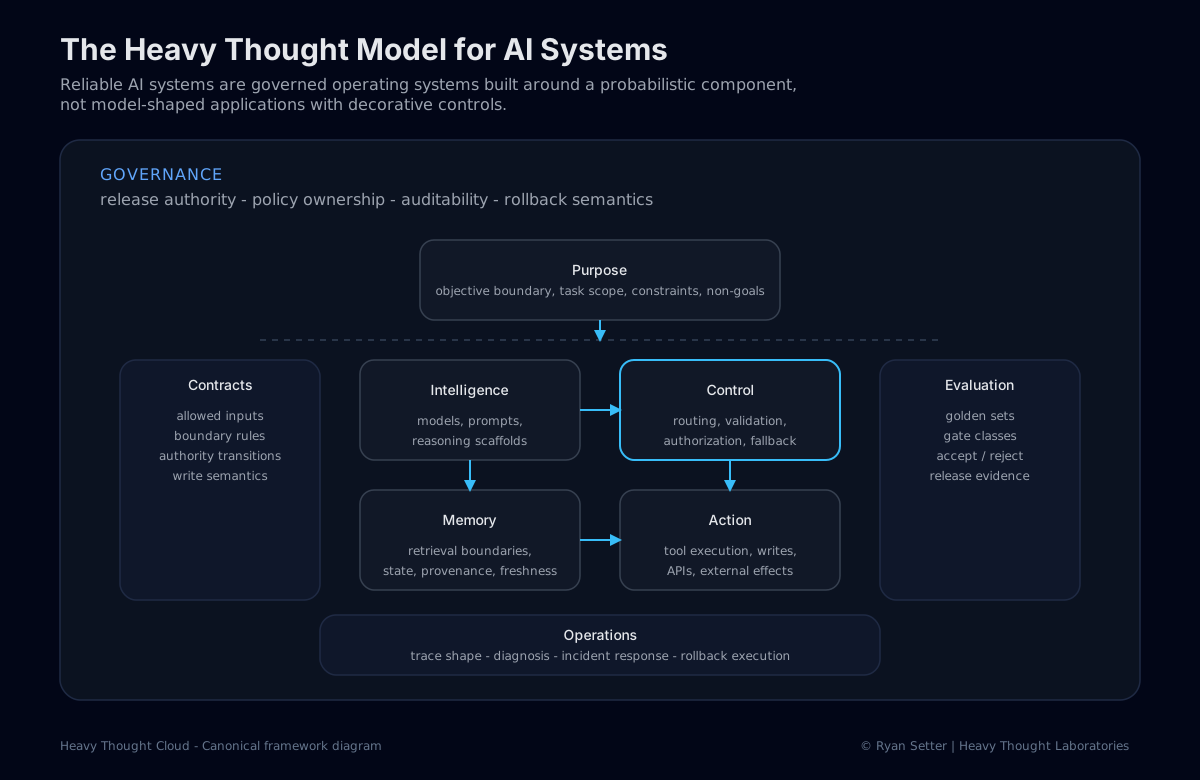
Reliable AI systems are governed operating systems built around a probabilistic component, not model-shaped applications with decorative controls.
Layers define where capability lives. Disciplines define how it is governed across those layers.
The public model reads as a governed operating system: purpose constrains the system, control governs the operational core, and governance encloses the whole path.
purpose
Defines what the system is allowed to optimize for and what outcomes count as success or failure.
Intent must be explicit before intelligence is trusted.
intelligence
Generates probabilistic outputs from models, prompts, tools, and reasoning scaffolds.
The model is a component, not the architecture.
control
Constrains, routes, validates, and authorizes how intelligence is used.
Reliability comes from governed transitions, not optimistic generation.
memory
Supplies bounded system context and durable state.
Memory defines what the system can know and how safely it can know it.
action
Translates approved decisions into external effects.
External effects require explicit authority.
governance
Defines the authority model over the whole system and enforces release, audit, and accountability discipline.
This layer encloses all others.
Governance encloses the system; it is not a decorative afterthought.
Cross-Cutting Disciplines
These are not layers. They apply across all layers.
Each discipline manifests differently at each layer - evaluation in intelligence is statistical, while evaluation around action becomes authorization- and consequence-bound.
Cross-Cutting Discipline
Define allowed inputs, outputs, boundaries, and authority transitions.
Systems fail when contracts stay implicit and boundaries become interpretive.
Cross-Cutting Discipline
Determines whether behavior is acceptable before and after release.
Evaluation is release authority for probabilistic behavior, not reporting garnish.
Cross-Cutting Discipline
Operational posture: Make the system observable, diagnosable, and recoverable in production.
If the system cannot be traced and recovered, it is not production-ready.
Axioms
Axiom 01
The model is not the product. It is one probabilistic component inside a governed system.
Architecture must be described at the system level, not at the prompt level.
Axiom 02
Probabilistic generation must be surrounded by deterministic boundaries for routing, validation, authority, and failure handling.
Reliability comes from the shell more than from confidence in the model itself.
Axiom 03
No meaningful write, mutation, or irreversible action should occur without an explicit control contract.
Action surfaces are governed by authorization, not optimism.
Axiom 04
Memory design determines what the system is allowed to know, what it can cite, and where its knowledge boundaries end.
Retrieval quality, isolation, provenance, and freshness are architectural concerns.
Axiom 05
A system that cannot be evaluated against meaningful gates cannot be responsibly released.
Model, prompt, retrieval, policy, and workflow changes all require evidence before release.
Axiom 06
Trace design is useful only when it makes regressions, boundary failures, and operator decisions legible.
Logs without causal shape are paperwork with timestamps.
Axiom 07
Auditability, ownership, rollback, and policy enforcement are architectural requirements, not compliance accessories.
Systems without governance are prototypes with better lighting.
Doctrine Map
The framework is not a separate content universe. It is the organizing spine for the doctrine already live across Heavy Thought Cloud, especially across control, memory, evaluation, and governance surfaces.
purpose // contracts + evaluation + operations
Macro thesis for treating AI as a governed systems layer rather than a prompt trick.
memory // contracts + operations
Memory-layer depth across retrieval boundaries, storage choices, and context strategy.
governance // contracts + operations
Operational implementation posture for building governed AI systems in practice.
control // contracts + evaluation + operations
The macro containment pattern for reliable AI system design.
action // contracts + operations
Authority-bound action pattern for state-changing and irreversible system effects.
governance // evaluation + operations
Operational trace shape for diagnosis, attribution, and failure reconstruction.
memory // evaluation
Evaluation discipline for regression detection across changing probabilistic systems.
governance // evaluation + operations
Failure-class language for distinguishing symptoms, causes, and missed controls.
governance // contracts + evaluation + operations
Release authority model for changes to probabilistic systems and their boundaries.
memory // contracts + evaluation + operations
Memory-boundary doctrine for admissibility, isolation, provenance, and runtime enforcement.
control // contracts + evaluation + operations
Runtime-governance doctrine for binding control across routing, retrieval, outputs, tools, and live rollback posture.
governance // contracts + evaluation + operations
Anchor doctrine page that maps the whole framework into one public architecture model.
Framework Doctrine
This page is the citation surface. The anchor article now carries the longer argument for why reliable AI systems must be designed as governed operating systems rather than model-shaped applications with hopeful controls.