By Ryan Setter
The Architecture of Long-Term Memory in AI Systems
A systems-first guide to the AI memory layer: memory architecture, retrieval boundaries, storage posture, context strategy, and the operational tradeoffs behind durable AI systems.
Revision // 2/18/2026
Series // AI Infrastructure Foundations // Part 2 of 3
Why Memory Is the Real Capability Multiplier
The current market often treats memory as a retrieval feature add-on. That framing is too narrow.
Without memory architecture, AI systems remain session-bound and shallow. They can generate coherent local output, but they cannot sustain cumulative intelligence across time, teams, and workflows.
This is where many prototypes stall. The model looks impressive, but the system never learns enough durable context to become operationally useful.
In AI as Infrastructure, we established that memory is one layer in a larger architecture stack. Here, we open that layer and design it explicitly.
The Context Window Myth
Bigger context windows are useful, but they are not a substitute for memory architecture.
Three practical constraints make this obvious:
- Cost grows with repeated inclusion of large context payloads.
- Latency grows with token volume and retrieval expansion.
- Reliability declines when relevance ranking drifts under broad context noise.
Large context buys temporary convenience. It does not provide lifecycle control, semantic durability, or memory quality guarantees.
When that convenience turns into an operational spend problem rather than a design smell, the applied essay is Cost Spike Control in AI Systems.
Framework: The Memory Stratification Model
This is the second core framework for Heavy Thought Cloud.
Layer 1: Ephemeral Context
The active prompt window and immediate request payload. High relevance, zero persistence.
Layer 2: Session Memory
Conversation continuity scoped to a user interaction period. Useful for short-running tasks and state carryover within a bounded interaction.
Layer 3: Project Memory
Persistent memory scoped to a specific domain boundary: repository, product area, or initiative. This includes decisions, glossary terms, architecture constraints, and implementation artifacts.
Layer 4: System Memory
Cross-project semantic index and structured references that support transfer and reuse of concepts across domains.
Layer 5: Institutional Memory
Organization-level knowledge architecture: policy knowledge, historical decisions, canonical patterns, postmortems, and governance records.
The core design principle is separation by scope and lifetime. Mixing layers creates noise, leakage, and governance risk.
Retrieval Is Not Memory
RAG is necessary but not sufficient.
A retrieval pipeline that can fetch chunks is not equivalent to a memory system that can preserve, evolve, and validate knowledge over time.
Common failure modes:
- Chunking that destroys semantic boundaries.
- Embedding drift across model upgrades.
- Stale indexes after source changes.
- Missing provenance and confidence metadata.
- No invalidation strategy after corrections.
Treat retrieval as one memory access mechanism, not the memory architecture itself.
If you want a field guide for retrieval choices under real production constraints, see Retrieval Strategy Playbook.
Coupling Orchestration and Memory
Memory quality depends on orchestration discipline.
A useful control loop looks like this:
- Retrieve candidate context with explicit scope filters.
- Rank and compress context by task relevance.
- Execute model step with bounded context budget.
- Evaluate output quality and policy adherence.
- Persist durable artifacts back into the right memory layer.
If step five is missing or undisciplined, your system cannot compound intelligence.
If step three stops being bounded in practice, the operational consequence is usually cost drift before anyone calls it architecture. That is the field case behind Cost Spike Control in AI Systems.
Diagram Reuse from Article 1
The memory layer does not stand alone. It is constrained by orchestration, integration, and governance from the broader stack.
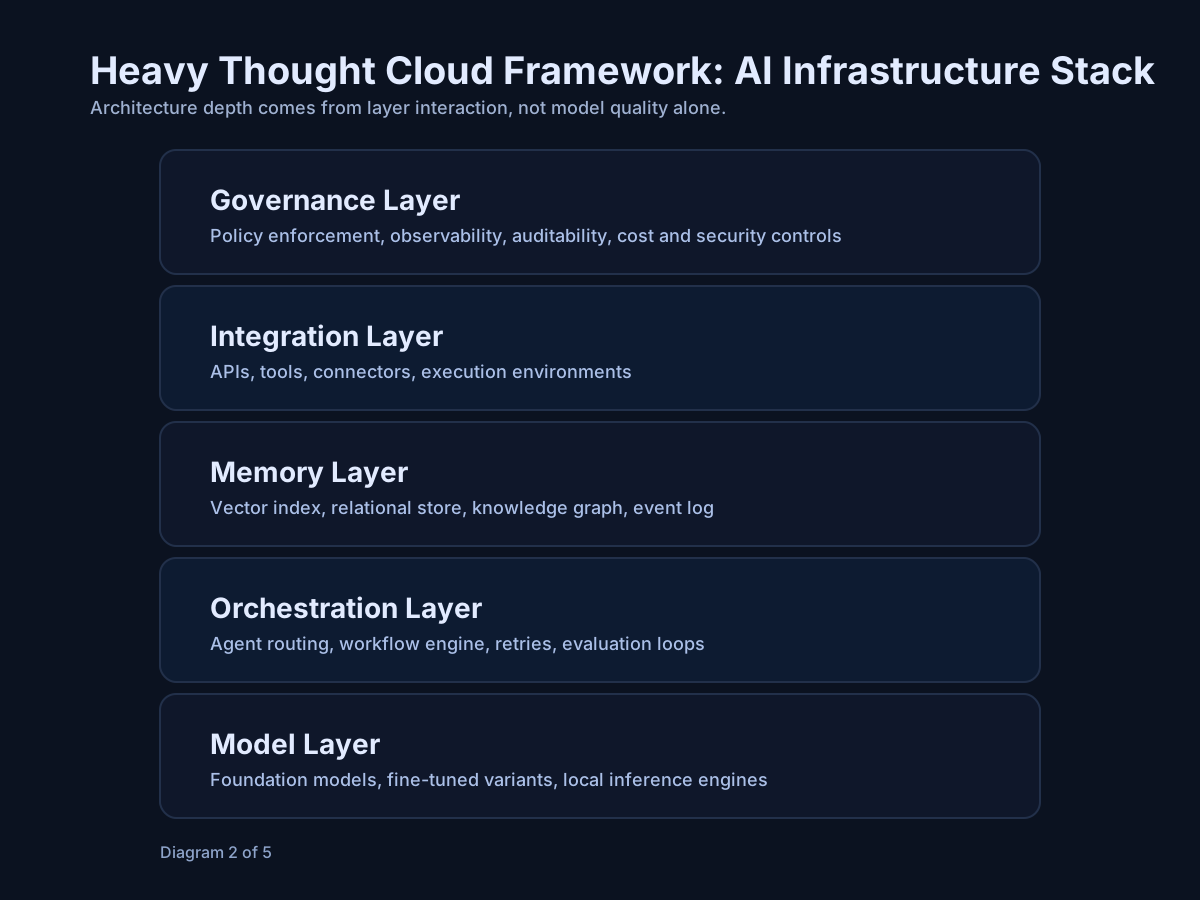
Figure A. Memory as one layer in the full architecture stack. See the original anchor in Article 1.
Memory behavior is also controlled by the system control plane, not by model inference in isolation.
That is where Policy Enforcement in AI Systems stops being abstract governance language and becomes a memory authority model: it decides which evidence, environments, and source classes are admissible at runtime. When retrieval boundaries, index rules, or provenance logic change, Evaluation Gates: Releasing AI Systems Without Guesswork is what gives those changes release authority before production quietly learns a new memory policy by accident.
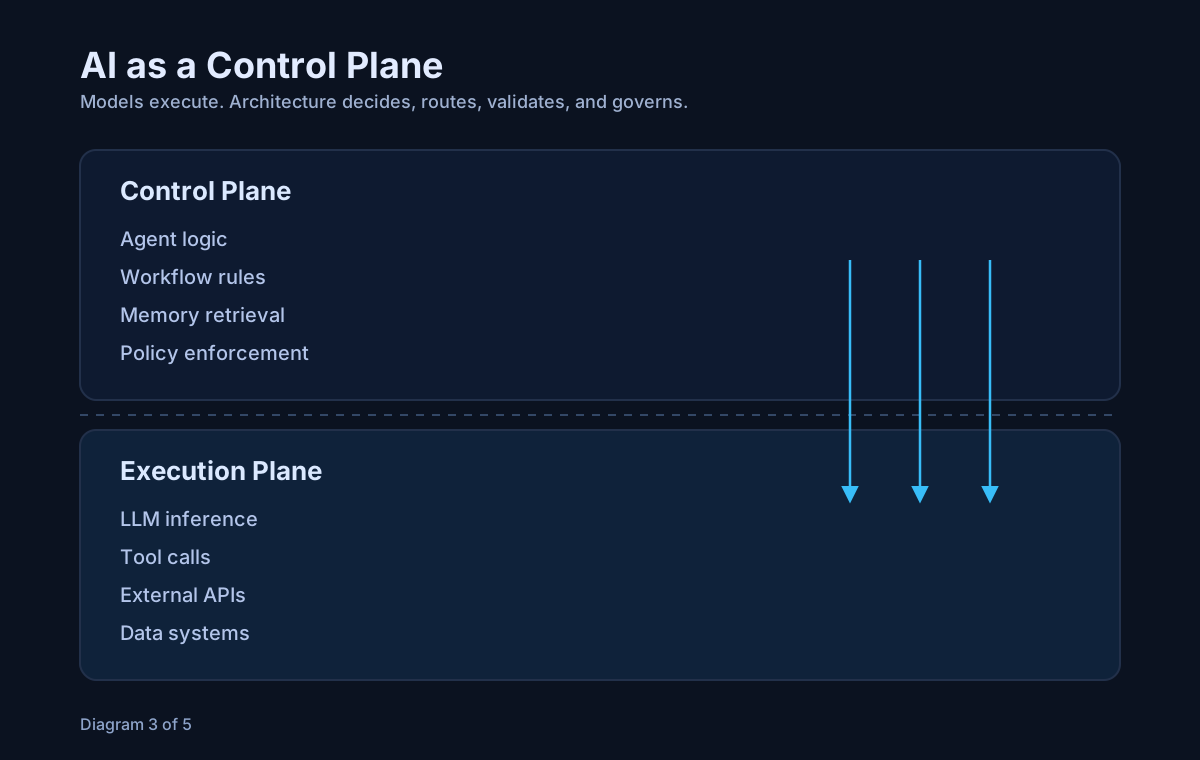
Figure B. Control-plane constraints determine memory quality and policy compliance. Original diagram anchor in Article 1.
Choosing Memory Primitives by Need
Use the simplest durable primitive that satisfies the requirement:
- Vector index for semantic recall.
- Relational store for deterministic state and reporting.
- Knowledge graph for typed relationships and reasoning paths.
- Event log for temporal history and replayability.
Architectural errors often come from forcing one store type to solve all memory problems. Stratification prevents that.
Local vs Cloud Memory Tradeoffs
Memory placement is not a religious decision. It is a boundary decision.
Local-first memory patterns help when:
- Data sensitivity is high.
- Latency budget is tight.
- Cost predictability matters.
Cloud memory patterns help when:
- Team-wide sharing is primary.
- Capacity and replication need to scale quickly.
- Managed operations reduce complexity.
Hybrid patterns are usually the practical default: local project memory for velocity and privacy, cloud-backed institutional memory for shared continuity.
Reliability Requirements for Memory Systems
If memory participates in product behavior, it must be tested like any other critical subsystem.
Minimum reliability controls:
- Version indexes and retrieval schemas.
- Track provenance for all persisted memory entries.
- Define index invalidation and rebuild triggers.
- Run semantic regression tests on key workflows.
- Instrument retrieval quality metrics over time.
For the broader engineering posture around those controls, see Architecture Principles for AI Products.
A Practical Blueprint
For most engineering teams, a durable first implementation looks like:
- Session cache for active interaction continuity.
- Project vector store with strict namespace boundaries.
- Relational store for decisions, policy metadata, and artifact references.
- Periodic compaction pipeline to prune stale or low-signal entries.
- Evaluation harness that validates retrieval relevance on known queries.
This is enough to move from stateless assistant behavior to persistent system behavior.
Connection to the Full Stack
Memory architecture only works when connected back to the rest of the AI Infrastructure Stack:
- Model layer determines encoding quality and retrieval comprehension.
- Orchestration layer controls when and how memory is accessed.
- Integration layer governs source-of-truth ingestion paths.
- Governance layer constrains retention, access, and auditability.
A memory layer in isolation is a data pile. A memory layer in architecture is leverage.
Next: Operationalizing This in Engineering Workflows
In Designing an AI-Native Development Stack, we map memory and orchestration into day-to-day development patterns, model routing decisions, and toolchain design.
If you want the underlying model/runtime framing beneath memory design, see Generative AI: A Systems and Architecture Reference.
For the larger six-layer architecture that places memory inside a governed system rather than as an isolated subsystem, see The Heavy Thought Model for AI Systems and the concise framework hub.
If you want the runtime admissibility boundary inside that memory layer - what the system is allowed to know at all - see Retrieval Boundaries: What Your AI System Is Allowed to Know.
Related Reading
- AI as Infrastructure: Why the Next Decade Will Be Architected, Not Prompted
- Designing an AI-Native Development Stack
- The Heavy Thought Model for AI Systems
- Retrieval Boundaries: What Your AI System Is Allowed to Know
- Retrieval Strategy Playbook
- Architecture Principles for AI Products
- Generative AI: A Systems and Architecture Reference
Closing Position
Long-term capability in AI systems is not primarily a model problem.
It is a memory architecture problem.
When memory is stratified, versioned, and governed, AI behavior compounds. When memory is implicit and unmanaged, systems stay clever but forgetful.