By Ryan Setter
AI as Infrastructure: Why the Next Decade Will Be Architected, Not Prompted
Prompting is an interface. Architecture is the leverage layer that determines reliability, cost, and long-term capability.
Revision // 2/18/2026
Series // AI Infrastructure Foundations // Part 1 of 3
The Prompting Illusion
Most public discussion around AI still centers on prompts.
Write better prompts. Engineer chains. Tweak phrasing.
This is understandable because prompts are visible. Architecture is not.
But prompting is a surface interaction model, not a systems model. It feels powerful while workloads are small and stakes are low. As soon as reliability, compliance, latency, and cost ceilings enter the room, prompt quality alone stops being the bottleneck.
We have seen this pattern before. Early web applications were mostly templates and scripting glue. Real scale forced us toward service boundaries, deterministic interfaces, orchestration, and operational control planes. AI is now crossing the same line.
From Tooling to Systems
Every durable computing shift follows a familiar arc:
- Primitive tools appear.
- Reusable patterns emerge.
- Infrastructure solidifies around the primitives.
LLMs are primitives.
The shift is not that models can generate more words. The shift is that organizations are building systems that route, constrain, evaluate, and operationalize model behavior over time.
That is why "AI assistant" framing is already too small for production reality. We are building an architectural subsystem that must be observable, governable, and resilient under non-ideal conditions.
Key Takeaways
- AI is becoming a systems layer, not a prompt optimization game.
- The model is only one layer; orchestration, memory, integration, and governance create production value.
- Reliability comes from deterministic controls wrapped around probabilistic behavior.
Framework: The AI Infrastructure Stack
This is the first core framework for Heavy Thought Cloud.
Layer 1: Model Layer
Foundation models, specialized variants, and local inference runtimes. This layer provides probabilistic reasoning and generation. It does not provide policy, workflow guarantees, or institutional memory by itself.
Layer 2: Orchestration Layer
Agent loops, routing, retries, decomposition, evaluator passes, fallback logic. This layer is where system behavior gets composed, and where workflow determinism is imposed around stochastic model calls.
Layer 3: Memory Layer
Vector indexes, relational stores, event logs, and knowledge graphs. This layer preserves continuity across sessions and gives the system access to project and institutional context that cannot fit in transient prompts.
Layer 4: Integration Layer
Tool adapters, internal APIs, third-party connectors, and execution sandboxes. This layer lets AI systems interact with real environments instead of producing disconnected text artifacts.
Layer 5: Governance Layer
Policy enforcement, access boundaries, observability, cost controls, audit trails, and compliance controls. This is where enterprise legitimacy lives.
For the engineer-first operating posture that falls out of this layer, see Architecture Principles for AI Products.
If your architecture only talks about the model, it is equivalent to describing a distributed system by naming only the database.
Why Architecture Replaces Prompting
Prompt engineering optimizes inside a request. Architecture optimizes across time.
Production AI requires control over:
- Latency budgets and p95 targets
- Token economics and throughput ceilings
- Failure semantics and retry boundaries
- Policy checks and deterministic guardrails
- Memory coherence and retrieval quality
None of those concerns are solved by wording tricks. They are solved by system design and operations discipline.
When cost control fails under real workload pressure rather than in architecture slides, the applied essay is Cost Spike Control in AI Systems.
If you want the model-level substrate in more detail, see Generative AI: A Systems and Architecture Reference.
The Enterprise Shift Already Underway
Enterprises do not deploy prompts. They deploy systems with accountability.
That means:
- Explicit control boundaries
- Service-level objectives
- Incident response playbooks
- Cost and usage governance
- Security posture that survives audits
The job market signal will follow architecture reality. "Prompt engineer" is a transitional role label. Durable demand will cluster around AI systems architects, cognitive infrastructure engineers, and memory-aware platform teams.
What Engineers Should Build Next
If you want to remain compounding-relevant over the next decade, build depth in:
- Agent orchestration with clear failure paths.
- Memory design with versioning and invalidation strategy.
- Hybrid local-plus-cloud model execution.
- Evaluation pipelines and regression harnesses.
- Observability that measures behavior, not just uptime.
The architectural objective is straightforward: make probabilistic systems behave predictably enough to trust in real workflows.
If you want the most useful mental model for that containment problem, start with Probabilistic Core / Deterministic Shell.
Once containment exists, the next question is operational: when the system fails, can you classify the failure precisely enough to improve the right boundary? That is the job of Error Taxonomy: Classifying AI System Failures Before They Become Incidents.
Decision Criteria
- Are the model, orchestration, memory, integration, and governance layers explicit?
- Does policy authority live in deterministic system controls rather than model output?
- Is memory treated as versioned infrastructure instead of prompt-stuffed convenience?
- Are evaluation, observability, and cost control designed as runtime disciplines rather than later patches?
If you want the field-shaped version of that last question, see Cost Spike Control in AI Systems.
Failure Modes
- Treating the model as the architecture
- Confusing prompt quality with production reliability
- Leaving memory implicit, unversioned, or operationally unowned
- Adding governance after deployment instead of designing it into the system boundary
- Shipping without evaluation and trace visibility
Diagrams
These five diagrams are a visual vocabulary for the cornerstone series.
1) Prompt-Centric vs Architecture-Centric
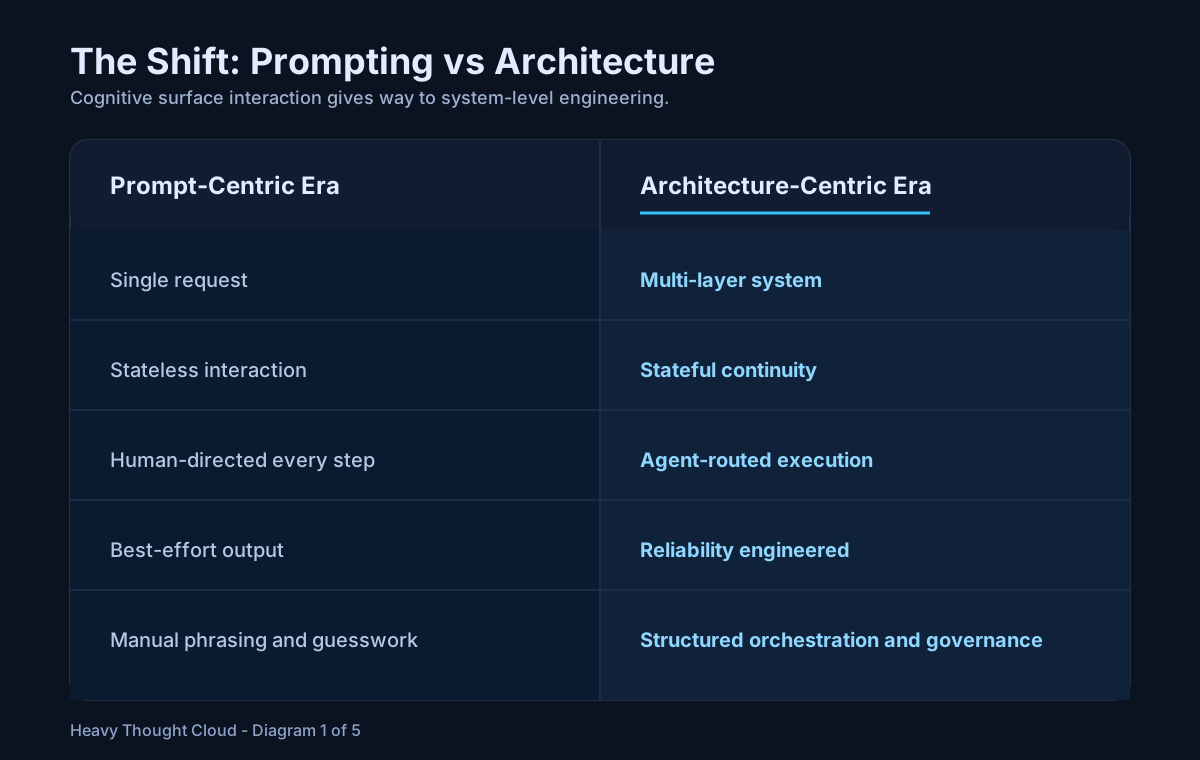
Figure 1. The operating shift from request-level prompting to layered systems architecture.
2) AI Infrastructure Stack
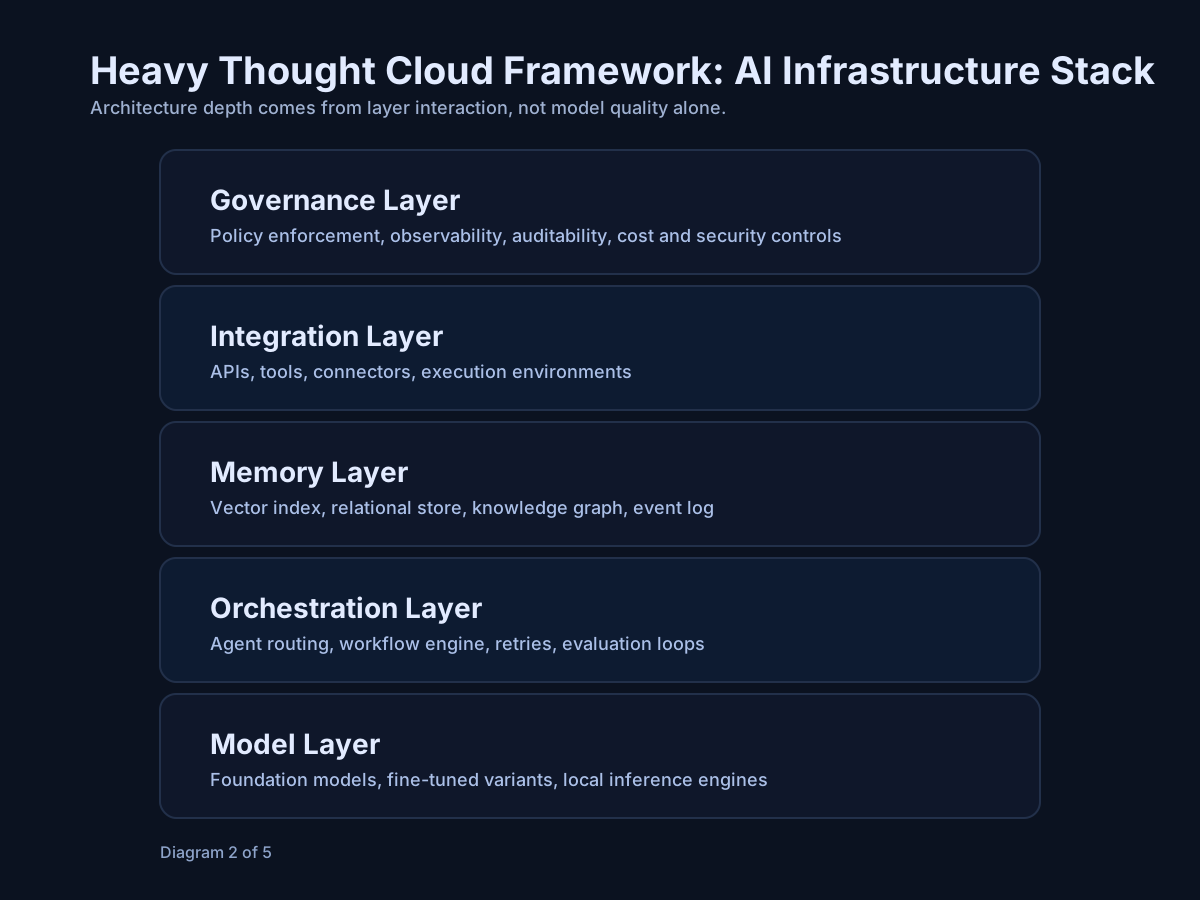
Figure 2. The five-layer AI Infrastructure Stack: model, orchestration, memory, integration, and governance.
3) Control Plane vs Execution Plane
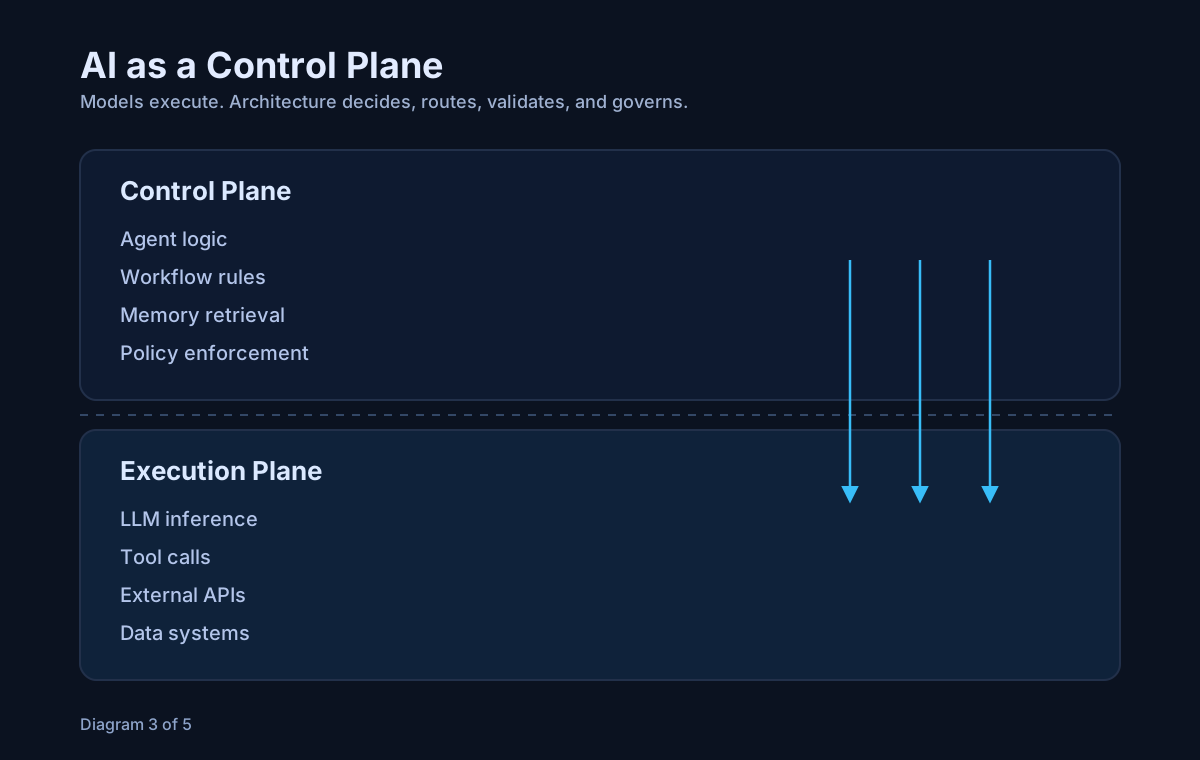
Figure 3. Control-plane logic governs policy, memory, and routing; execution-plane services perform the work.
4) Temporal Optimization Model
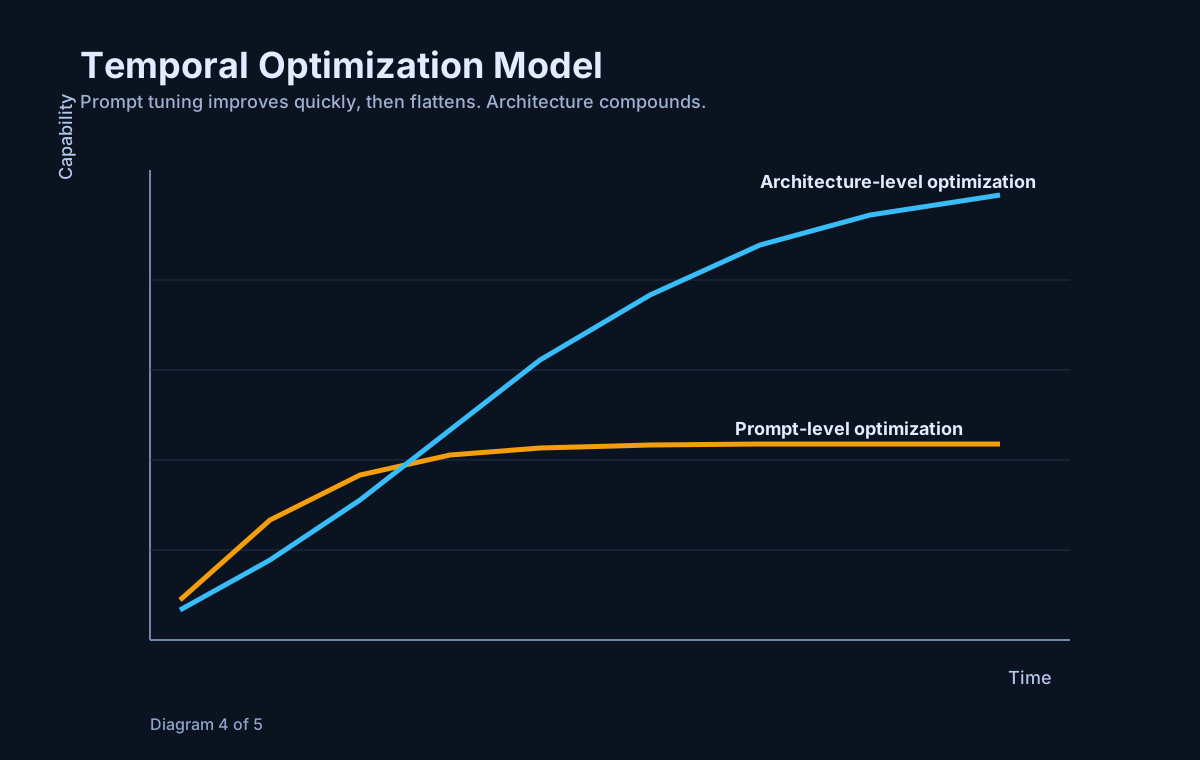
Figure 4. Prompt tuning delivers early gains; architecture compounds capability over time.
5) Probabilistic Core + Deterministic Shell
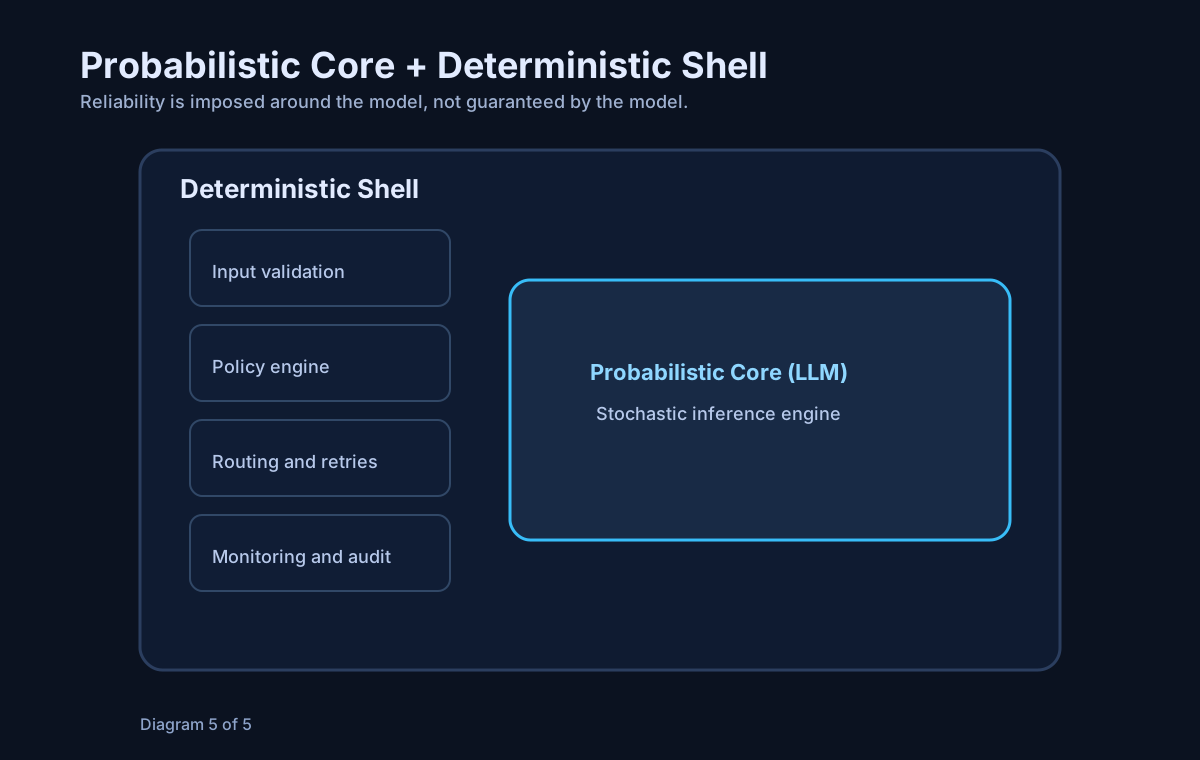
Figure 5. Reliability comes from deterministic infrastructure wrapped around a stochastic model substrate.
These are not decorative assets. They encode the architecture language used across this series.
Where This Series Goes Next
In The Architecture of Long-Term Memory in AI Systems, we expand the Memory Layer into a stratified architecture: ephemeral context, session continuity, project memory, and institutional memory.
In Designing an AI-Native Development Stack, we operationalize the stack into practical engineering workflows and tooling patterns.
For the supporting doctrine pages that make the stack operable, continue with Architecture Principles for AI Products, Generative AI: A Systems and Architecture Reference, and Probabilistic Core / Deterministic Shell.
For the full governed model that now consolidates those layers and control disciplines, see The Heavy Thought Model for AI Systems and the concise framework hub.
Related Reading
- The Architecture of Long-Term Memory in AI Systems
- Designing an AI-Native Development Stack
- The Heavy Thought Model for AI Systems
- Architecture Principles for AI Products
- Generative AI: A Systems and Architecture Reference
- Probabilistic Core / Deterministic Shell: Containing Uncertainty Without Shipping Chaos
- Error Taxonomy: Classifying AI System Failures Before They Become Incidents
Closing Position
AI is not becoming useful because prompts are improving.
AI is becoming useful because it is being embedded into engineered systems.
Prompting is an interface. Infrastructure is the leverage.
The next decade belongs to teams that design for systemic depth, not cognitive theater.