By Ryan Setter
Designing an AI-Native Development Stack
A practical architecture for combining agents, local models, cloud models, and project memory into a durable engineering workflow.
Revision // 2/18/2026
Series // AI Infrastructure Foundations // Part 3 of 3
AI-Native Is Not "Autocomplete Plus"
Most teams still treat AI tooling as an enhancement layer on top of a conventional development stack. That creates local productivity gains, but it does not produce an AI-native engineering system.
AI-native means architecture changes, not just plugin adoption.
In AI as Infrastructure, we defined the macro shift from prompting to systems. In The Architecture of Long-Term Memory in AI Systems, we designed memory as a layered subsystem. This article operationalizes both into day-to-day engineering practice.
Framework: The AI-Native Dev Stack Model
This is the third core framework for Heavy Thought Cloud.
Layer 1: Human Intent Layer
Problem framing, architecture decisions, constraints, and acceptance criteria. Humans remain accountable for direction and judgment.
Layer 2: Agent Layer
Task decomposition, iterative reasoning loops, tool invocation, and quality checks. Agents are execution amplifiers, not autonomous strategy owners.
Layer 3: Model Layer
Local and cloud models selected by workload profile, latency, privacy, and synthesis depth.
Layer 4: Tooling Layer
CLI tools, editors, test runners, build systems, static analyzers, and deployment interfaces exposed as callable capabilities.
Layer 5: Memory Layer
Session memory, project memory, and institutional references scoped to prevent context leakage and drift.
Layer 6: Execution Layer
Source control, CI/CD, runtime environments, observability, and release governance.
AI-native maturity comes from clean contracts between these layers, not from model novelty.
Diagram Reuse from Article 1
The move from prompt-centric habits to architecture-centric workflows is the starting condition for an AI-native stack.
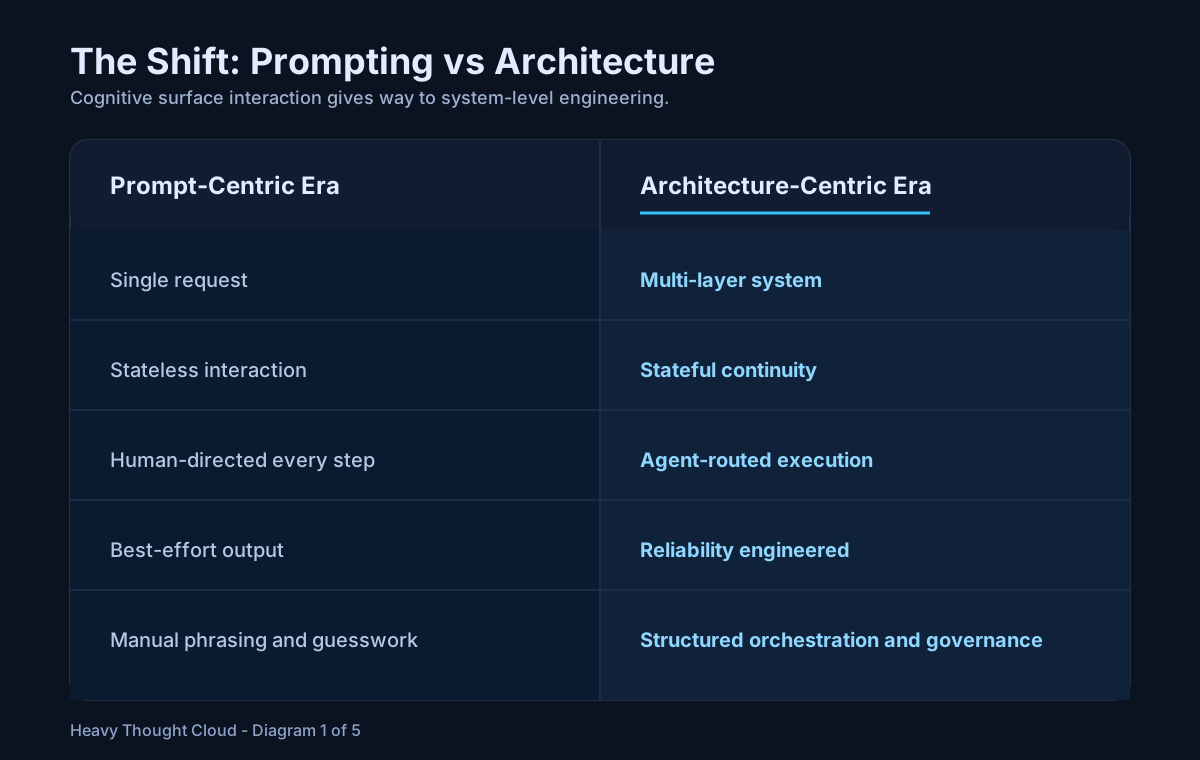
Figure A. AI-native development starts by moving from prompt tactics to systems architecture. Original diagram anchor in Article 1.
AI-native execution also depends on deterministic infrastructure wrapped around probabilistic model calls.
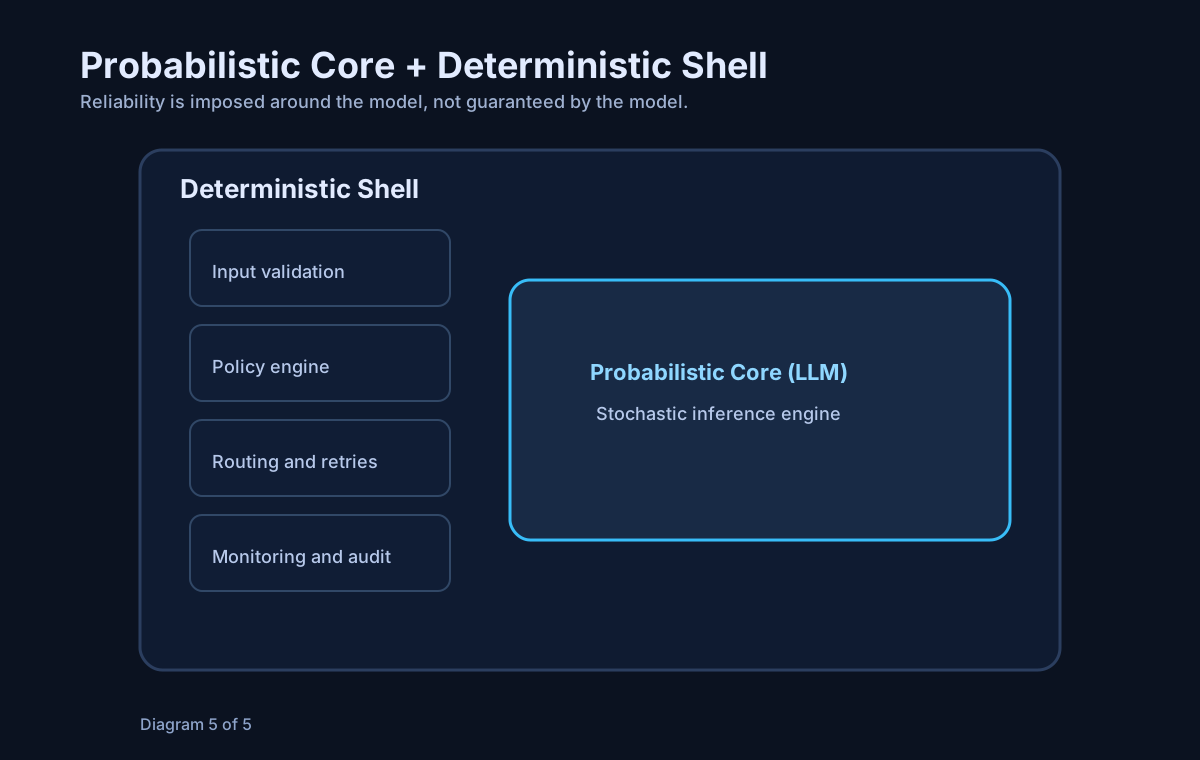
Figure B. Deterministic wrappers are what make agent workflows dependable in production. Original diagram anchor in Article 1.
Local Models vs Cloud Models: A Boundary Decision
The right split is architectural, not ideological.
Local models excel for:
- Rapid iteration on code transformations.
- Private repository work and sensitive domain data.
- Predictable cost under sustained usage.
Cloud models excel for:
- Deep synthesis and broad reasoning tasks.
- Larger context needs and stronger frontier quality.
- Shared services across teams.
A practical baseline is hybrid routing: local-first for iterative loops, cloud escalation for high-complexity synthesis and final-pass reasoning.
That containment logic is the same one formalized in Probabilistic Core / Deterministic Shell.
Agent Skills Architecture
Agentic systems are only as reliable as their skill boundaries.
Treat each skill as a contract with:
- Explicit inputs and outputs.
- Tool access constraints.
- Failure and retry semantics.
- Validation criteria.
- Observability hooks.
This creates legible behavior and makes agent workflows testable. Without skill contracts, agent systems drift into opaque behavior that is hard to debug and harder to trust.
If you want the operating rules for making those contracts survive production, see Architecture Principles for AI Products.
Practical Workflow Pattern
A durable AI-native engineering loop looks like this:
- Human defines goal, constraints, and acceptance checks.
- Agent explores codebase and proposes a constrained plan.
- Local model iterates quickly on implementation changes.
- Cloud model performs synthesis and architecture-level review.
- Agent runs lint, typecheck, and build gates.
- Memory layer records decisions, rationale, and known pitfalls.
This keeps throughput high without sacrificing architectural control.
Concrete Stack Example
One practical setup for this site context:
- Editor/runtime: VSCodium plus terminal-first workflows.
- Agent interface: OpenCode CLI for structured tool orchestration.
- Local inference: Ollama-hosted models for private, low-latency loops.
- Cloud fallback: API-routed frontier model for synthesis and hard cases.
- Project memory: file-based notes and scoped retrieval in repository context.
- Execution controls: git discipline, lint/typecheck/build verification, deploy gating.
The point is not tool brand loyalty. The point is stable interfaces and swappable components.
For the retrieval boundary inside that stack, see Retrieval Strategy Playbook.
Designing for Longevity
Most AI stacks fail from coupling, not capability.
To stay durable:
- Decouple model providers behind stable internal interfaces.
- Keep memory schemas versioned and migration-friendly.
- Isolate agent behavior in declarative skill definitions.
- Preserve deterministic test and release gates.
- Avoid burying architecture-critical policy inside prompts.
Common Failure Modes
Patterns that repeatedly degrade AI-native teams:
- Agent sprawl without capability boundaries.
- Prompt-only governance and missing deterministic controls.
- Unscoped memory that leaks across projects.
- No regression harness for agent workflows.
- Over-indexing on model quality while ignoring system design.
These failures are avoidable when stack layers are explicit and continuously validated.
Implementation Roadmap for Teams
If you are early in the transition, sequence work in three phases:
Phase 1: Foundation
- Define stack layers and contracts.
- Establish local-first workflow for safe iteration.
- Add baseline quality gates for AI-assisted changes.
Phase 2: Reliability
- Introduce structured agent skills.
- Add memory stratification with versioning.
- Instrument orchestration and retrieval behavior.
- Gate side-effecting agent actions with Two-Key Writes.
Phase 3: Scale
- Standardize shared prompts, policies, and skills.
- Add cloud escalation paths and cost controls.
- Build team-wide playbooks for incidents and drift.
When those escalation and cost controls stay vague long enough to become a budget incident, the applied essay is Cost Spike Control in AI Systems.
This sequence avoids premature complexity while preserving architectural direction.
For the consolidated public model that now ties stack, memory, control, action, and governance into one doctrine surface, see The Heavy Thought Model for AI Systems and the concise framework hub.
Related Reading
- AI as Infrastructure: Why the Next Decade Will Be Architected, Not Prompted
- The Architecture of Long-Term Memory in AI Systems
- The Heavy Thought Model for AI Systems
- Probabilistic Core / Deterministic Shell: Containing Uncertainty Without Shipping Chaos
- Architecture Principles for AI Products
- Retrieval Strategy Playbook
Closing Position
AI-native development is not a productivity trick. It is a stack redesign.
When done well, engineers keep strategic control while delegating repetitive execution to agentic systems. When done poorly, teams accumulate opaque automation debt and lose trust in outputs.
Treat the stack as infrastructure, and it compounds.