The Heavy Thought Model for AI Systems
A governed control-plane doctrine for reliable AI architecture: six layers, three disciplines, and one coherent model for turning probabilistic capability into operable systems.
By Ryan Setter
AI systems fail because they are not designed as systems.
Most teams can list the pieces of an AI system.
- model
- prompt
- retrieval
- tools
- evals
- maybe a policy doc someone mentions when the room gets nervous
That is not the same thing as being able to describe the architecture.
Without a shared model, serious concerns get split into local conversations:
- memory gets treated like a retrieval feature
- evaluation gets treated like testing
- governance gets treated like compliance paperwork
- operations gets treated like logging after the real design is finished
That is how systems stay half-designed while everyone involved still feels busy.
The Heavy Thought Model for AI Systems exists to stop that drift. It gives one named structure for where capability lives, where authority lives, and which disciplines keep the full system operable.
For the concise diagram and model hub, see /framework.
The Model
The Heavy Thought Model treats AI as a governed operating system built around a probabilistic component.
It uses six architectural layers:
PurposeIntelligenceControlMemoryActionGovernance
It also uses three cross-cutting disciplines:
ContractsEvaluationOperations
The point is not to invent a prettier stack diagram.
The point is to make three things explicit:
- what the system is trying to do
- what the probabilistic component is allowed to influence
- what gives the full system release, audit, and rollback authority
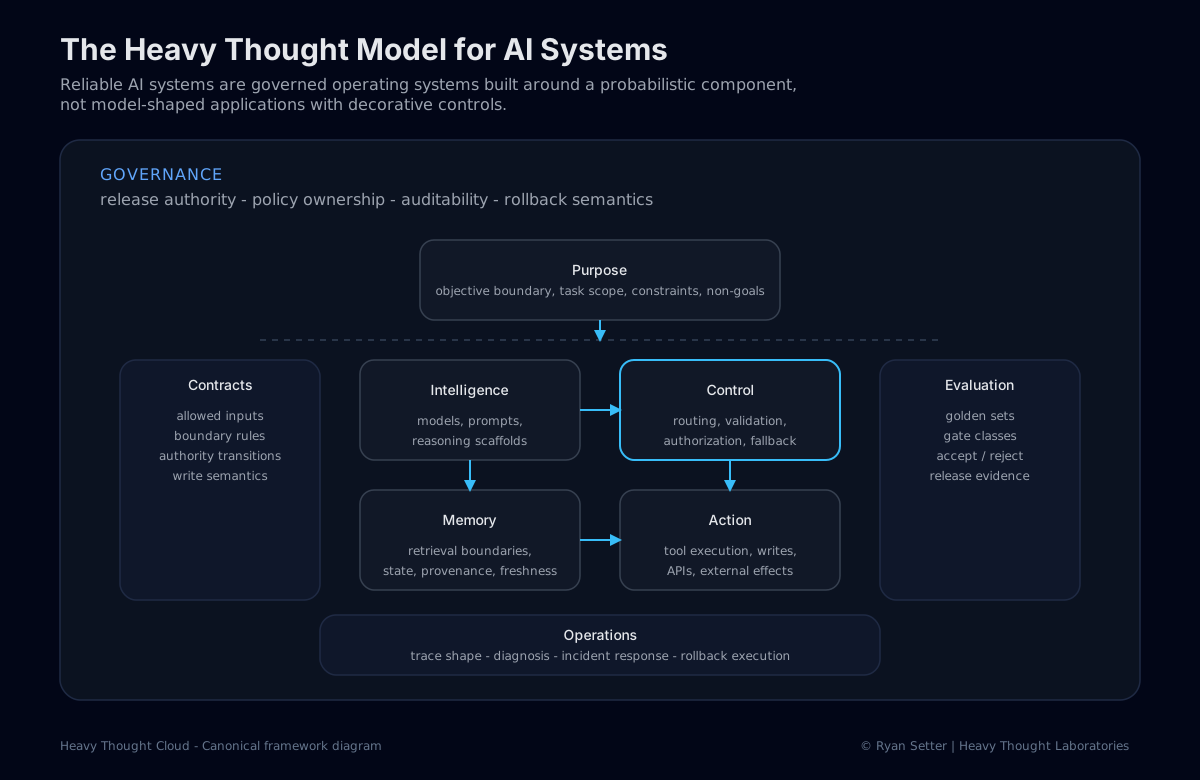
The Heavy Thought Model reads AI systems as governed operating systems: purpose constrains the path, control governs the core, and governance encloses the whole thing.
Key Takeaways
- AI architecture becomes legible when capability, control, memory, action, and governance are named as separate concerns instead of being folded into one model-shaped blob.
- Governance is not the last box in the flow. It is the authority layer that encloses release, audit, rollback, and policy ownership across the whole system.
- Layers answer where behavior lives. Disciplines answer how that behavior stays governable.
- The current Heavy Thought Cloud doctrine corpus already describes this model in pieces; this page names the full system explicitly.
- If a team cannot point to its purpose boundary, control layer, memory boundary, and release authority, it does not yet have an AI architecture. It has a workflow with ambition.
Why This Model Exists
Generic AI diagrams usually fail in one of two ways.
The first failure is model-centrism.
The model sits in the middle, everything else becomes accessory trim, and the resulting architecture quietly implies that quality is mostly a property of inference.
That is backwards.
In production, reliability comes less from the model than from the system that routes it, constrains it, feeds it evidence, interprets its outputs, and decides whether any of those outputs are allowed to cross a real boundary.
The second failure is governance flattening.
Evaluation, auditability, rollback, trace requirements, and policy ownership get pushed into a footer labeled ops, compliance, or monitoring, as if those concerns arrive after the architecture is already real.
They do not arrive after the architecture.
They determine whether the architecture is operable at all.
The Heavy Thought Model exists because AI systems need a frame that is closer to an operating model than a component list. It has to show where uncertainty lives, where control is imposed, where knowledge enters, where side effects happen, and who has authority over the entire path.
The Six Layers
1) Purpose
When purpose is vague, the rest of the architecture starts inventing intent.
Retrieval widens past the right scope. Refusal logic becomes inconsistent. Evaluation ends up scoring behavior against a target nobody pinned down in the first place.
Purpose exists to force the first hard boundary:
- what this system is for
- what it is not for
- which tasks belong to automation
- which outcomes require escalation or refusal
If that boundary is weak, every downstream layer inherits confusion instead of direction.
2) Intelligence
Intelligence is where the system is allowed to be probabilistic.
Models, prompts, reasoning scaffolds, ranking behavior, and tool-planning logic live here because useful AI behavior requires non-rigid capability.
That is exactly why intelligence cannot also be where authority lives.
If fluent output starts counting as a system decision by itself, the architecture has already surrendered the hard part.
3) Control
Control is where the system refuses to be charmed by output.
This layer routes requests, validates results, applies policy, enforces budgets, authorizes actions, and chooses fallbacks when the probabilistic component gets expensive, unsafe, or vague.
If intelligence is where the system proposes, control is where the architecture decides what is allowed to count.
This is where Probabilistic Core / Deterministic Shell stops being a phrase and becomes a real operating boundary.
4) Memory
Memory is where knowledge enters the system under rules.
If retrieval scope, provenance, freshness, and working-state boundaries stay implicit, the system can sound informed while operating on the wrong evidence.
That is why memory is a boundary surface, not a convenience feature.
When memory design is weak, the architecture does not merely forget. It reasons from the wrong world model.
5) Action
Action is where costs become real.
Tool calls, writes, notifications, and downstream API mutations are where a bad answer turns into an operational incident.
If this layer is not explicitly governed, the system graduates from being wrong to being dangerous.
That is also why action never gets to inherit authority by implication.
6) Governance
Governance is what stops the rest of the model from behaving like an ambitious prototype.
Release authority, auditability, rollback semantics, policy ownership, and operator override posture all live here.
It encloses the architecture because those powers determine whether any other layer is allowed to ship, continue, or cross a real boundary.
Layers Are Not Disciplines
One of the easiest ways to muddy AI architecture is to mix operating surfaces with control disciplines.
Layers answer:
- where behavior lives
- where state changes happen
- where authority has to be expressed
Disciplines answer:
- how those layers stay explicit
- how regressions are detected
- how failures become reconstructable instead of mysterious
If a team starts calling evaluation a layer, governance a workflow checkbox, or operations a post-launch function, the architecture usually drifts back toward component theater.
Each discipline manifests differently depending on the layer it crosses.
Evaluation in intelligence is statistical.
Evaluation around action becomes authorization- and consequence-bound.
Contracts in purpose define objective boundaries.
Contracts in action define what the system is allowed to change.
The Three Disciplines
Contracts
Contracts define what is allowed across every meaningful boundary.
That includes input shape, output shape, allowed transitions, retrieval scope, tool permissions, write authority, and explicit unknown handling.
Without contracts, the system still runs. It just runs interpretively.
Interpretive systems are excellent at surprising their operators.
Evaluation
Evaluation determines whether behavior is acceptable before and after release.
This includes regression sets, policy suites, boundary checks, gate classes, and evidence thresholds.
Evaluation matters because probabilistic systems do not become trustworthy through confidence or style. They become trustworthy through evidence with authority.
Without that authority, evaluation is a dashboard with excellent self-esteem.
Operations
Operations makes the system observable, diagnosable, and recoverable under real pressure.
That means trace shape, failure classification, incident handling, budget visibility, rollback execution, and enough causal context to understand what actually happened.
Without operations, the architecture can still demo beautifully. It just cannot survive contact with production.
Example: Reading One Workflow Through The Model
Take a support copilot that answers account questions, retrieves tenant-scoped evidence, drafts a response, and can optionally update a ticket.
Read through the model:
| Model element | What it means in this workflow |
|---|---|
Purpose | resolve support questions within product scope and policy boundaries |
Intelligence | synthesize answers, rank candidate evidence, plan tool use |
Control | route to retrieval, validate citations, block unsafe output, require escalation when confidence or policy thresholds fail |
Memory | tenant documentation, case history, product references, provenance, freshness rules |
Action | draft reply, tag case, update ticket state, trigger approved downstream workflows |
Governance | release gates, audit trail, rollback rules, policy ownership, operator override posture |
Then read the disciplines across it:
Contractsdefine tenant isolation, response schema, and write authority.Evaluationdecides whether retrieval changes or prompt changes are allowed to ship.Operationsensures traces and incident paths are good enough to diagnose regressions later.
This is the practical value of the model.
A retrieval-index change is no longer just a data tweak. It is a Memory change surface that must pass Evaluation, remain legible through Operations, and still respect the authority model defined by Governance.
How The Current Doctrine Maps To The Model
The framework is not a new content lane pretending to be profound.
It is the named architecture that ties the existing doctrine together.
The cornerstone essays establish the macro frame:
- AI as Infrastructure: Why the Next Decade Will Be Architected, Not Prompted shifts the conversation from prompting to systems.
- The Architecture of Long-Term Memory in AI Systems opens the memory layer as a real subsystem.
- Designing an AI-Native Development Stack operationalizes the stack into engineering practice.
The Layer 1 doctrine pages then define the control surfaces inside the model:
- Probabilistic Core / Deterministic Shell: Containing Uncertainty Without Shipping Chaos defines the containment boundary between capability and control.
- Two-Key Writes: Preventing Accidental Autonomy in AI Systems governs authority over external effects.
- The Minimum Useful Trace: An Observability Contract for Production AI gives operations a reconstructable trace contract.
- Golden Sets: Regression Engineering for Probabilistic Systems turns change detection into disciplined evidence.
- Error Taxonomy: Classifying AI System Failures Before They Become Incidents gives production failures a shared language.
- Evaluation Gates: Releasing AI Systems Without Guesswork gives evidence authority over release behavior.
- Retrieval Boundaries: What Your AI System Is Allowed to Know defines what evidence is admissible inside the reasoning path before retrieval quality debate begins.
- Policy Enforcement in AI Systems: Turning Governance into Runtime Control turns governance into binding runtime control across routing, retrieval, outputs, tools, and live rollback posture.
The model matters because those pages are not isolated essays. They are manuals for different parts of the same governed system.
Failure Modes When Teams Skip The Model
Model-shaped architecture
The system gets described mostly in terms of prompts, models, and tool calls. Control, memory boundaries, and release authority become background concerns.
The result is a system that sounds coherent in demos and becomes vague the moment something fails.
Retrieval as a feature, not a boundary
Memory gets reduced to search quality or vector-database configuration. Provenance, isolation, freshness, and evidence authority stay implicit.
That is how teams end up building rumor engines with support for citations.
Evaluation without authority
The team runs tests, benchmarks, and review workflows, but none of them can actually stop a bad change from shipping.
That is not release discipline. That is optimistic reporting.
Governance after the fact
Auditability, rollback, policy ownership, and incident response appear only after the workflow becomes risky.
By then the architecture is already leaning on assumptions it never made explicit.
Operations too late to explain failure
Logs exist, but traces do not reconstruct the path well enough to show what boundary failed, which control missed it, or what should change in release policy afterward.
That is how incidents become stories instead of engineering inputs.
Closing Position
AI systems do not become reliable because the model gets smarter.
They become reliable because the architecture gets stricter about where uncertainty belongs, what authority can cross a boundary, and which disciplines are allowed to decide whether the system is fit to ship.
This is the minimum architecture for reliability.
Anything less is still a prototype negotiating with production.
Related Reading
- Framework
- AI as Infrastructure: Why the Next Decade Will Be Architected, Not Prompted
- The Architecture of Long-Term Memory in AI Systems
- Designing an AI-Native Development Stack
- Probabilistic Core / Deterministic Shell: Containing Uncertainty Without Shipping Chaos
- Two-Key Writes: Preventing Accidental Autonomy in AI Systems
- The Minimum Useful Trace: An Observability Contract for Production AI
- Golden Sets: Regression Engineering for Probabilistic Systems
- Error Taxonomy: Classifying AI System Failures Before They Become Incidents
- Evaluation Gates: Releasing AI Systems Without Guesswork